

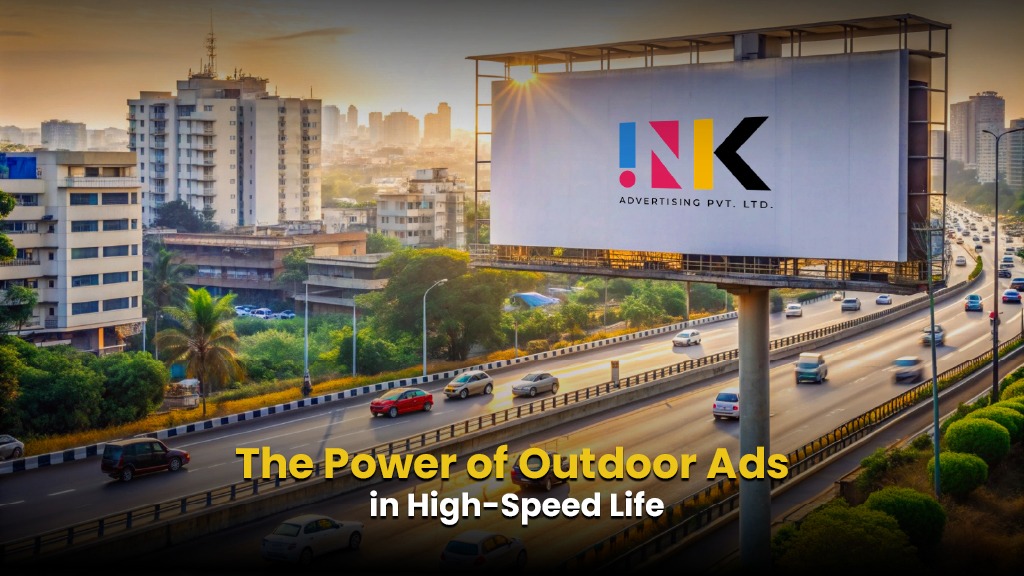
Why Outdoor Advertising Drives High Recall?
Have you ever noticed that when you walk through any city, like Delhi, Mumbai, Bengaluru, or any other where you live, there is one consistent behavioural pattern: people instinctively look around at their surroundings?
Digital ads compete on tiny mobile screens, but outdoor advertising competes for attention in the real world across multiple formats such as roads, highways, metro stations, airports, tech parks, mall exteriors and access roads, cinema complexes, residential hubs, transit media, kiosks, and digital screens.
And despite the digital boom, brands continue to invest large budgets in OOH (Out-of-Home) simply because it delivers one thing better than any other medium: high recall. In this blog, we’ll explore why outdoor advertising (OOH) continues to provide powerful recall, the types of OOH formats, recent trends, reasons brands allocate huge budgets to it, and how agencies like INK craft unforgettable outdoor campaigns.
The Psychology of Recall: Why Outdoor Ads Stay in the Mind
Audiences remember outdoor advertisements, and brands prefer outdoor media, primarily due to one psychological effect of passive repetition. Outdoor ads are encountered naturally, not because people choose to see them, but because they exist in their physical path. whether on roads, transit spaces, waiting zones, or public gathering points.
- Repetition builds memory: When you cross the same visual on a hoarding, bus shelter, metro panel, or digital screen over multiple days, the message sticks.
- High-attention locations: On flyovers, metro entry and exit queues, station concourses, escalators, skywalks, and transit corridors where eyes naturally linger.
- Non-fragmented exposure: Outdoor visuals occupy a single large uninterrupted canvas, not a small screen full of distractions.
That’s why an outdoor advertising agency in Delhi NCR or any city can turn a simple idea into citywide recognition, simply by placing ads in the right locations where people see them repeatedly.
High Footfall + Repetition = Unmatched Visibility
While digital media fights for seconds of attention, outdoor media benefits from citywide familiarity. Let’s take an example of an office goer in Delhi who travels from Dwarka to CyberHub. They see:
- Kiosk or bus shelter branding near bus stops
- A large-format board outside a toll junction
- A rotating LED screen at a corporate signal
- Metro entry–exit zone panels and station exterior branding during transit
Even if they never consciously “engage” with any of these ads, they get registered subconsciously. That’s how outdoor advertising becomes powerful: It doesn’t demand attention. It earns attention. Brands that understand visibility psychology invest confidently because OOH becomes part of a city’s identity, and people remember it without effort.
Why Do Brands Still Allocate Significant Budgets to Outdoor Advertising?
Budgets follow behaviour. And human behaviour in cities revolves around movement, repeat routes, and public spaces. OOH offers benefits that many digital channels cannot:
- Presence at scale: One prime hoarding can outperform thousands of low-impact digital impressions.
- Trust-building: If a brand can afford a 40-foot board, people assume it is legitimate.
- Cross-channel synergy: A fan sees a brand online → then on a highway → then outside a mall = conversion momentum.
This is why OOH remains a go-to strategy for tech startups, FMCG leaders, real estate brands, and premium retail brands alike. Their objective is simple: own attention in the real world, not just online. And this is exactly where leading outdoor advertising companies help brands stand out, scale their presence, and stay memorable.
Why High-Traffic Areas Are the Perfect Stage for Large-Format Impact?
Outdoor advertising performs best where people move, gather, travel, and socialise, whether it’s a metro city or a fast-growing tier-II hub. Wherever there is consistent public movement, outdoor media becomes part of everyday life. Think of busy office roads, commercial markets, shopping districts, highways, airports, or entertainment zones. These spaces capture attention naturally, without asking for it.
In such environments, outdoor advertising is no longer just a promotional space; it becomes part of the consumer journey. A massive billboard for a new smartphone along a major expressway, a perfume ad at a bustling airport, or a car display near a high-footfall mall, we don’t simply notice them; we remember them. They form visual cues of aspiration, lifestyle, and brand personality.
This isn’t a “metro phenomenon.” Globally and locally, cities of all sizes show the same behavioural pattern: Wherever people move with purpose, outdoor formats leave stronger impressions. From business districts to busy transit routes, OOH builds visibility, scale, and cultural association that no digital banner can replicate.
Why Agencies Matter: Strategy + Design + Placement?
Outdoor success is not just about booking a hoarding; it is about understanding the science behind visibility across different outdoor formats. The placement must serve the audience, the message must be readable at speed, the colours must stand out, and the copy must say everything in 6-7 words. This is the craft of OOH.
A seasoned outdoor advertising agency in India, like INK Advertising Pvt. Ltd, ensures that a campaign is not only eye-catching but cleverly positioned across hoardings, transit media, and digital outdoor screens to generate recall. Without this precision, even the best artwork becomes invisible.
Where INK Advertising Makes the Difference?
INK Advertising has decades of mastery in visual storytelling and urban audience behaviour. As cities evolve, INK evolves with them, from iconic traditional hoardings to dynamic DOOH networks, transit branding, and integrated outdoor ecosystems. The agency has developed outdoor campaigns that don’t just advertise, but occupy cultural moments: bold, memorable, highly visible, and undeniably city-centric.
INK looks at OOH beyond media buying. It focuses on how design, geography, psychology, and brand personality converge on a single canvas. Whether it’s a metro train wrap, a landmark LED façade, or a series of hoardings across a business district, the objective remains the same: create advertising that people notice and never forget.
This commitment to integrated visibility aligns with the capabilities of the best digital marketing company in Delhi NCR, bridging outdoor dominance with online performance and brand awareness.
Conclusion
Outdoor advertising continues to thrive because human attention hasn’t moved entirely into mobile screens. Cities big or small are living theatres of movement, and outdoor media owns the stage. With repeated exposure, large-format visuals, and strategic placement in high-footfall zones, OOH continues to deliver unmatched recall and brand presence.
Brands that want to be remembered do not simply advertise where customers browse; they advertise where customers live, move, and look up. And that is exactly why outdoor will continue to remain one of the strongest pillars of modern marketing.


